This site presents A Regime Theory of Joy.
Home · Full Research Corpus · The Z-Reduction Task · Introduction (GitHub) · About
Independent researcher examining how evaluative monitoring shapes access to positive affect and contributes to shifts between regimes.
This is the principle underlying the M-ZRT exercises: each one interrupts a different form of optimization before recruiting its next policy.
The task is designed to test the hypothesis that temporarily suspending optimization alters access conditions to a distinct affective regime, where:
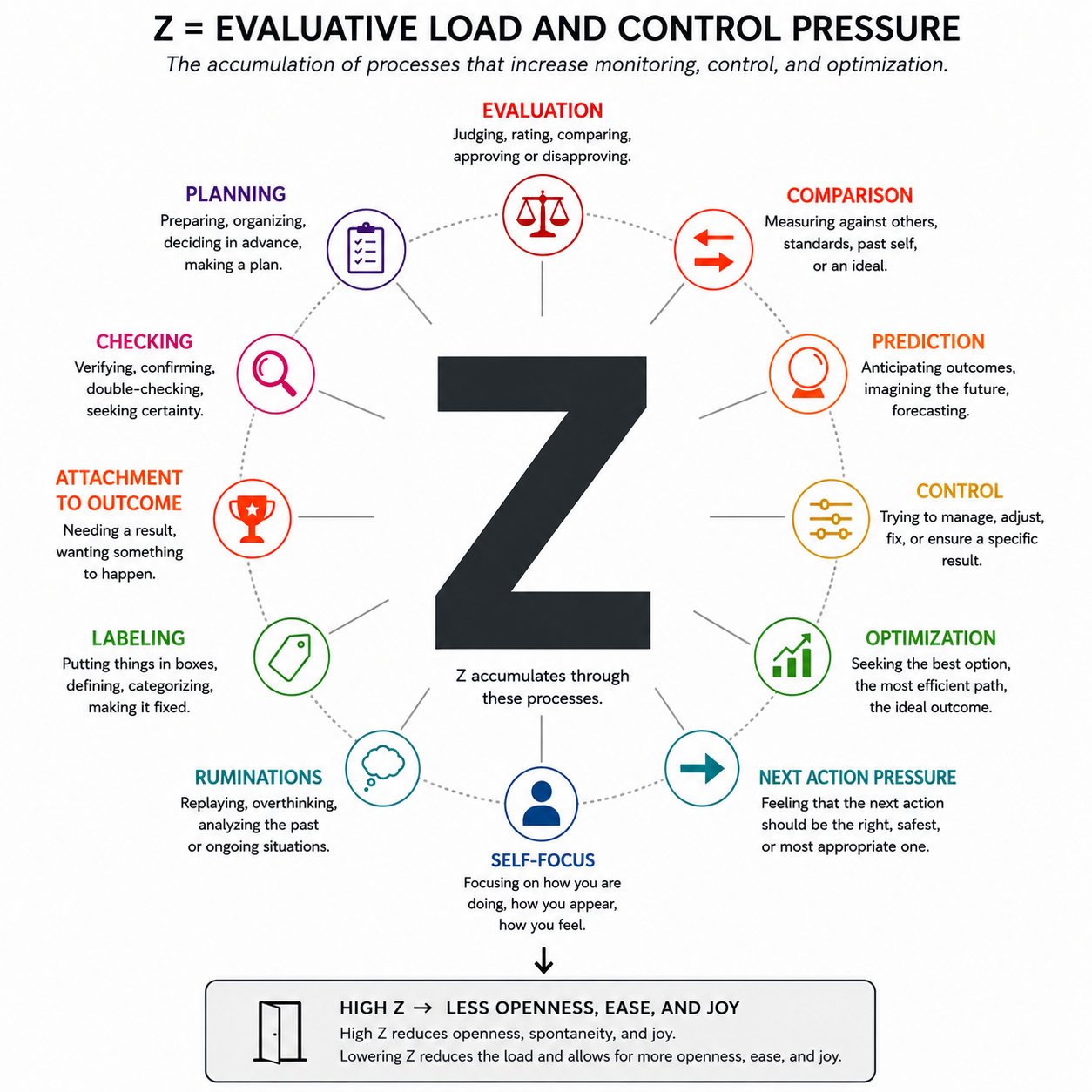
Z functions as a state variable tracking how much behavior is being evaluated and optimized. High Z increases monitoring and blocks entry into joy. Attempts to measure or intentionally reproduce the state may themselves raise Z, producing a measurement constraint.